About me

I am an astronomer, currently I work as ESPRIT fellow at the Institute for Astrophysics at the University of Vienna (Austria).
My primary research interests are the formation and evolution of galaxy centers. I study the assembly history of the Milky Way's nucleus, and radial stellar population gradients in early-type galaxies.

Expertise

  • Optical spectroscopy and near-infrared spectroscopy
  • IFU and longslit spectroscopy
  • Longslit drift scan observations
  • Resolved and unresolved stellar populations
  • Spectral fitting
  • Stellar kinematics
  • Dynamical modelling

My research

Nuclear star clusters are common objects in nearby galaxies. They are dense stellar systems, located at the center of galaxies.

Because the Milky Way nuclear star cluster is at a distance of only 8 kpc, we can spatially resolve its stellar populations and kinematics much better than in external galaxies. This makes the Milky Way nuclear star cluster a reference object for understanding the structure and assembly history of all nuclear star clusters.

I study the stellar kinematics of the Milky Way nuclear star cluster in integrated light towards the half-light radius (4.2pc). I run axisymmetric Jeans models and triaxial Schwarzschild models to understand the large-scale kinematics of the Milky Way nuclear star cluster.

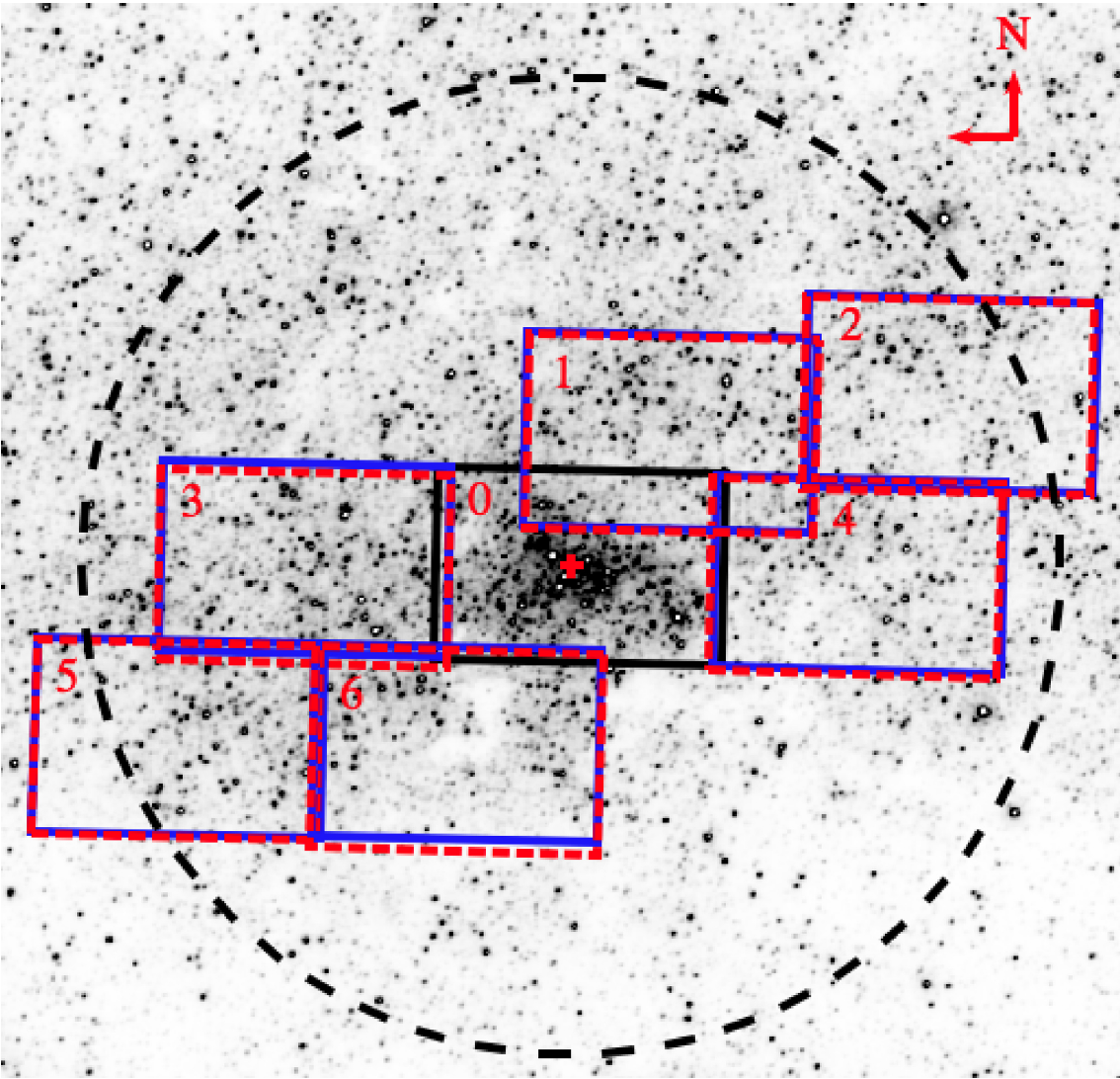
With near-infrared K-band spectroscopy of single resolved stars obtained with KMOS (VLT), I study the star formation history and metallicity distribution of the Milky Way nuclear star cluster. The data extend to a larger spatial scale than previous stellar populations studies of the Galactic centre. The dashed circle denotes the effective radius at 4.2 pc.

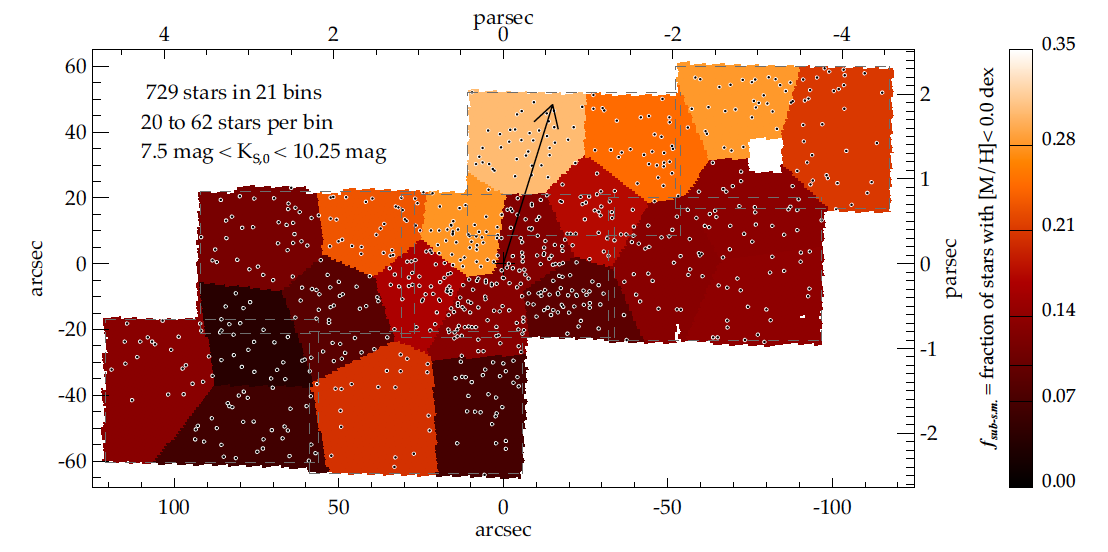
The mean metallicity of stars in the NSC is super-solar, though there is a wide range of metallicities. In the Galactic North and East of the NSC, the fraction of stars with sub-solar metallicity is ~30%, but only ~10% in the Galactic South.

Massive early-type galaxies are thought to have formed in two main stages: in an early (z~2) collapse of gas, stars formed in situ in a compact core. The second stage is ongoing to the present: satellite galaxies are accreted and deliver stars to the galaxy that were formed ex situ.

Most early-type galaxies show only little recent star formation, their stellar mass is dominated by old stars, and we can learn about galaxy assembly and early star formation from their stellar populations.

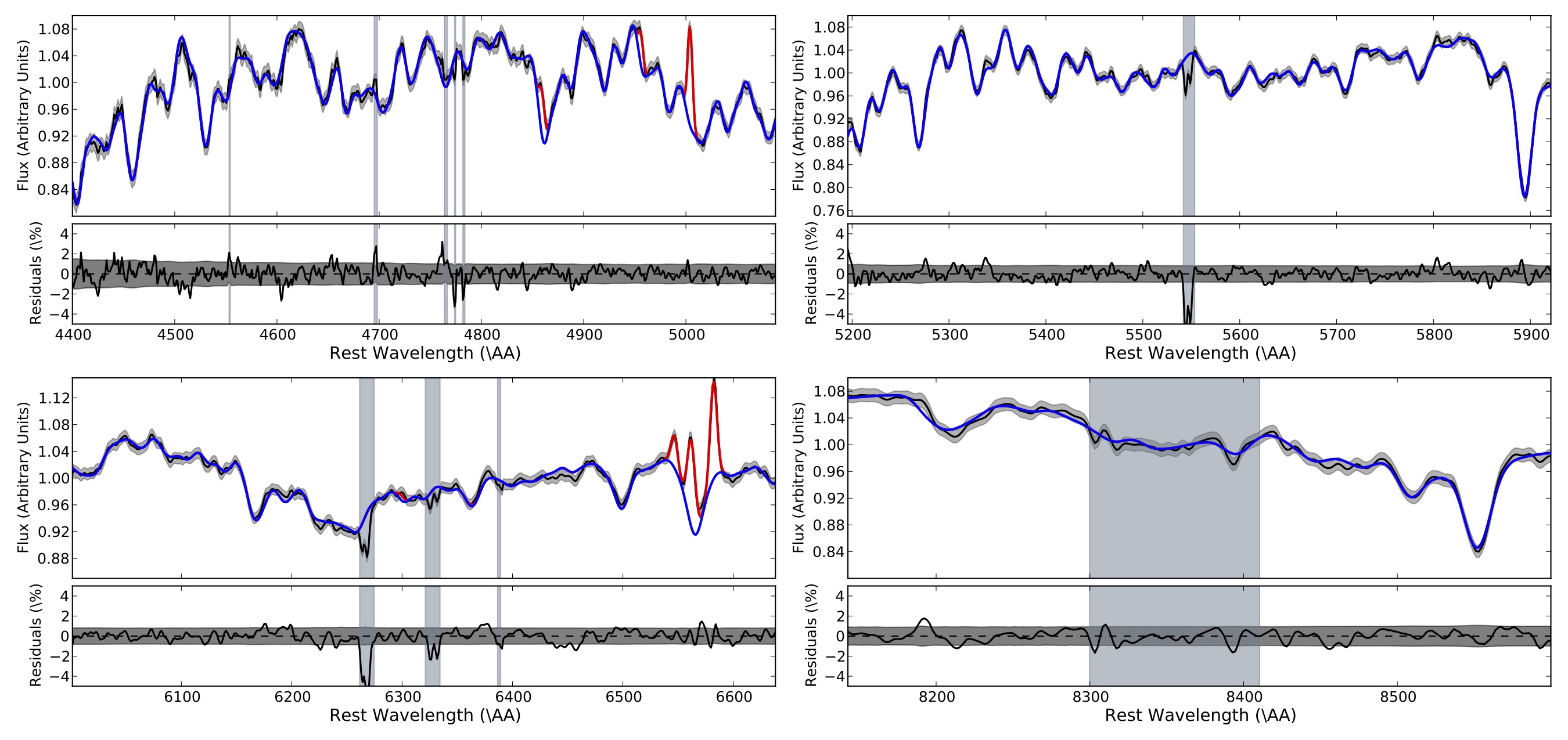
I use optical long-slit spectroscopy to extract information about the stellar populations of early-type galaxies as a function of their radius, out to ~1 effective radius. I fit the spectra with single stellar population models and constrain the stellar age, metallicity, elemental abundances, and low-mass IMF slope.

Publications

(complete ADS link)

Refereed publications (outdated)

Conferences and Selected Talks

2024 MODEST-24, Warsaw, Poland; Conference talk
2024 17. Marcel Grossmann Meeting, Pescara, Italy; Invited conference talk
2023 Galactic Center Workshop, Granada, Spain; Invited review talk
2023 Königstuhl Colloquium, MPIA, Germany; Colloquium
2023 Institute of Astrophysics at the Pontifical Catholic University of Chile, Chile; Institute Colloquium, remotely
2022 Granada, Spain; IAA Severo Ochoa Colloquium, remotely
2021 MW-Gaia Workshop, Heidelberg, Germany; Invited conference talk, remotely
2020 Conference for Undergraduate Women in Physics, Chicago, USA; LOC member
2018 KMOS@5 conference, Garching, Germany; Invited conference talk, remotely
2018 Michigan State University, USA; Astronomy & Astropophysics seminar
2017 Northwestern University, USA; CIERA special seminar
2017 Instituto de Astrofisica den Andalucia, Spain; Institute seminar
2017 McMaster University, Hamilton, Canada; Lunch talk
2017 The exiting lives of galactic nuclei, Ringberg, Germany; Invited conference talk
2017 University of Chicago, USA; Chalk talk
2016 Stellar aggregates over mass and spatial scales, Bad Honnef, Germany; Conference talk
2016 Leiden Observatory Colloquium, Leiden, Netherlands; Colloquium
2016 Königsstuhl Colloquium, MPIA, Germany; Colloquium
2015 Galactic nuclei at high resolution in many dimensions, Alajar, Spain; Blackboard Talk
2015 Formation, Evolution, and Survival of Massive Star Clusters, Honolulu, USA; Conference Talk
2015 Black Holes in Dense Star Clusters, Aspen, USA; Conference Talk
2014 Resolved And unresolved Stellar PopUlaTIoNs, Garching, Germany; LOC member
2014 Nuclear Clusters in Galaxies, and the Role of the Environment, Leiden, Netherlands; Conference Talk
2014 ISM-SPP student meeting, Freising, Germany; Conference Talk
2014 3D2014: Gas and stars in galaxies: A multi-wavelength 3D perspective, Garching, Germany; Conference Talk
2013 Black holes in a violent Universe, Granada, Spain; Conference Talk
2013 University of Utah, Salt Lake City, USA; Lunch Talk
2013 The Galactic Center: Feeding and Feedback in a Normal Galactic Nucleus, Santa Fe, USA; Conference Talk

Contact

Dr. Anja Feldmeier-Krause

Institut für Astrophysik
Universität Wien
Türkenschanzstraße 17,
A-1180 Wien

anja.krause (@) univie.ac.at
ORCID ID 0000-0002-0160-7221
ResearchGate